based on E.H. Nickel & M.C. Nichols (2009), H. Strunz & E.H. Nickel (2001)
6. BORATES
6.G: Unclassified borates
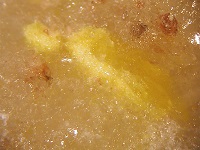 | 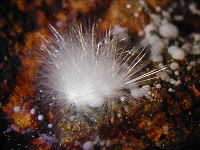 |  | |
| |
G = Grandfathered minerals: original description preceded the establishment of the CNMNC in 1959, and generally regarded as a valid species
A or IMA No. = Minerals approved by the CNMNC
Rd = Redefinition of the mineral approved by the CNMNC
Rn = Renamed with approval by the CNMNC
Q = Questionable mineral
Classification principles:
The classification is based on the linkage of borate triangles (BO3), symbol Δ, and borate tetrahedra (BO4), symbol □, to form fundamental building blocks (FBB) (see in Grice et al., 1999). According to the polymerization of the borate groups the subdivision is made now into Neso-, Soro-, Cyclo-, Ino-, Phyllo- and Tecto-borates, adapted from the well-known subdivision of the Silicates class and following the recommendation in Mills et al. (2009) on the standardization of mineral group hierarchies.
Borate minerals with unknown crystal structure are listed in this subclass 6.G.:
6.GA. Unclassified borates: Ca borates; Ca-Mg borates.
6.GB. Unclassified borates with additional other anions: With additional carbonate; with sulfate; with chromate.
Reference:
Grice, J.D.; Burns, P.C. & Hawthorne, F.C. (1999): Borate Minerals. II. A hierarchy of structures based upon the borate fundamental building block. Can. Min. 37, 731-762.
Mills, S.J.; Hatert, F.; Nickel, E. & Ferraris, G. (2009): The standardisation of mineral group hierarchies: application to recent nomenclature proposals. Eur. J. Mineral. 21, 1073-1080.
To distinguish from classical Strunz numbering, on hierarchical "group" level, a numbering with 3 digits is used, like "6.GA.005. Korzhinskite", instead of 2 digits (like "6.GA.05.") in the Strunz system.
© Thomas Witzke (2024)
