|
MINERAL FOTO ATLAS
Ciprianiite / Ciprianiit
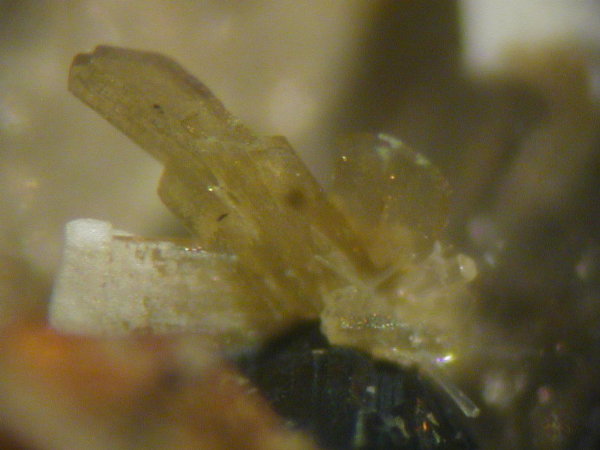
Light brownish crystals of ciprianiite. Monte Cavalluccio, Sacrofano, Roma, Italy. Picture size 1.8 mm. Collection and foto Thomas Witzke.
Hellbraune Kristalle von Ciprianiit. Monte Cavalluccio, Sacrofano, Rom, Italien. Bildbreite 1,8 mm. Sammlung und Foto Thomas Witzke.
|
Ciprianiit
Formel: Ca4[(Th,U)(REE)]Al(Ɛ,Be)2(Si4B4O22)(OH,F)2.
Strunz Systematik: Silikate. Hellandit-Gruppe.
Kristallsystem, Raumgruppe: monoklin (P2/a).
Gitterparameter: a = 19.059, b = 4.729, c = 10.291 Ǻ, beta = 111.32°, V = 864.0 Ǻ3, Z = 2.
Farbe: braun bis blass braun.
Strich: weiß.
Glanz: Glasglanz.
Durchsichtigkeit: durchsichtig bis durchscheinend.
Härte nach Mohs: .
Spaltbarkeit: undeutlich bis gut nach {100}. Bruch: .
Dichte: 3.61 (ber.).
Weitere typische Eigenschaften: keine Fluoreszenz im UV.
Optische Eigenschaften: nicht messbar.
Morphologie und Ausbildung: idiomorphe xx unter 0,5 mm Größe, tafelig nach {010}, häufig Zwillinge nach {100}.
Vorkommen: in miarolitischen Hohlräumen eines Sanidin-Plagioklas-Gesteines.
Begleitminerale: Sanidin, Plagioklas, Clinoamphibol, Magnetit, Titanit, Zirkon, Danburit, Thorit, Fluorit, Turmalin.
Erstbeschreibung: G.D. Ventura, P. Bonazzi, R. Oberti & L. Ottolini (2002): Ciprianiite and mottanaite-(Ce), two new minerals of the hellandite group from Latium (Italy).- Amer. Miner. 87, 739 - 744.
Name: nach Prof. Curzio Cipriani, Mineraloge, Museum für Mineralogie, Universität Florenz (Italien).
IMA: anerkannt (IMA 2001-021).
Typlokalität: Tre Croci, Vetralla, Latium (Italien).
Weitere Fundorte:
| |
|
© Thomas Witzke / Stollentroll
|